E-mail: [email protected]
Phone: +86-572-8356001
E-mail: [email protected]
Phone: +86-572-8356001
Content
Every 0.1% shift in pigment loading can alter impact strength by 3–5% in polyolefins. That level of sensitivity underscores why formulators must respect the chemistry—not just the color. A pigment is a finely divided solid that remains insoluble in the polymer matrix; it does not dissolve but disperses. A dye, on the other hand, dissolves at a molecular level. This solubility difference dictates everything: migration resistance, heat stability, and lightfastness. Pigments stay put. Dyes can bleed, especially in soft PVC or polyethylene under elevated temperatures.
Plastics processors overwhelmingly choose pigments for durable goods, packaging, and automotive parts. The inherent insolubility means pigment particles are physically locked inside the solid polymer after cooling. Consequently, migration is rare—unless the pigment is poorly dispersed or the polymer exceeds its solubility threshold. Dyes still have niche roles in transparent, high-gloss applications like PET bottles or polystyrene packaging, where true translucency is required. However, for most commercial uses, the migration resistance and thermal robustness of pigments offer a safer engineering margin.
A practical rule: if your part will face sunlight, repeated washing, or food contact, pigment is the safer route. For short-lived promotional items where cost trumps durability, dyes may suffice—but only after verifying no migration under end-use conditions.
Color selection starts with chemical backbone, not just a shade. All pigments fall into three broad families: organic, inorganic, and special effect. Organic pigments—often carbon-based—deliver wide color gamuts and high tinting strength, but their thermal ceiling hovers around 300 °C. Inorganic pigments, built on metal oxides or salts, offer unmatched weatherability and opacity, with heat stability routinely exceeding 500 °C. Special effect pigments—pearlescent, metallic, chameleon, and fluorescent—exploit light interference or metallic reflection to create luster that conventional pigment cannot replicate.
The table below distills what can span hundreds of data sheets into a practical selection matrix. Note that cost per kilogram is misleading; what matters is total cost per part, which we quantify in a later section.
| Property | Organic Pigments | Inorganic Pigments | Special Effect Pigments |
|---|---|---|---|
| Chemical base | Carbon-based molecules | Metal oxides, sulfides, chromates | Mica/TiO₂, aluminum, borosilicates |
| Typical color range | Broad (reds, blues, yellows) | Subdued (whites, blacks, earth tones) | Pearlescent, metallic, iridescent |
| Heat stability | 200–300 °C | >400–600 °C | 250–800 °C (depends on coating) |
| Lightfastness (Blue Wool) | 6–8 | 7–8 | 7–8 (with proper coating) |
| Weathering (QUV 2000h) | Moderate | Excellent | Good to excellent |
| Opacity | Low to medium | High | Depends on platelet size |
| Relative cost/kg | Medium–high | Low–medium | Medium–high |
| Typical loading in masterbatch | 10–40% | 20–50% | 5–25% |
Organic pigments dominate when intense, clean shades matter—think packaging reds or appliance blues. Inorganic pigments are the go-to for outdoor furniture, pipes, and building profiles where year-round UV exposure is a given. Special effect pigments transform packaging from commodity to premium. A pearlescent shampoo bottle, a metallic automotive interior trim, or a chameleon phone case—these are all born from specialty pearlescent technology that manipulates light reflection across platelet layers.
Spec sheets list dozens of values, but four parameters drive 90% of field failures. Heat stability, lightfastness, dispersibility, and migration resistance form the non-negotiable checklist for any plastic pigment. Each has an industry-standard test; skipping any of them converts a material cost saving into a warranty liability.
Polymer melts reach 230–280 °C for polyolefins, 240–260 °C for ABS, and up to 320 °C for polycarbonate. Pigment must survive dwell times of 5–10 minutes without decomposing or shifting hue. The standard ASTM D4459 runs a sample through multiple passes at target temperature, measuring color change (dE). A shift of dE > 2.0 is considered unacceptable for high-end goods. A heat-stable pigment for PC should show dE < 1.0 at 320 °C for 5 minutes.
Measured per ISO 105-B02 or the Blue Wool Scale (1–8), lightfastness determines how colors fade under artificial daylight. For indoor applications, 5–6 may suffice. For outdoor applications with 3+ years expected life, 7–8 is mandatory. Inorganic pigments inherently reach this level; many organics require UV stabilizer packages to approach it.
A pigment with perfect color but poor dispersion will cause streaks, specks, and mechanical weak points. Dispersion quality is often assessed via filter pressure value (FPV) according to EN 13900-5. For masterbatch production, a low FPV (<1 bar/g at 300 mesh) ensures uniform particle distribution. High FPV signals agglomerates that can clog screen packs and reduce opacity.
No one wants a red container bleeding onto a white shelf. Migration is tested per DIN 53775 or EN 20105-A03, where pigmented plastic is pressed against white PVC under controlled heat (typically 60–80 °C) and pressure. Results are rated 1 (severe staining) to 5 (no staining). For food packaging and medical devices, a rating of 5 is essential.
Combined, these four metrics create a fingerprint of reliability. A pigment that passes heat and migration but fails lightfastness will be rejected for automotive exteriors. One that disperses poorly will spike scrap rates in injection molding. Always request a technical data sheet that includes the test method, not just a numeric value.
Meeting color specs is only half the battle. If the part touches food, skin, or children’s mouths, a regulatory clearance is the price of entry. The three dominant frameworks—US FDA 21 CFR 178.3297, EU Regulation 10/2011, and China GB 9685—set strict limits on heavy metals, primary aromatic amines, and specific substances. A pigment approved in one region may be non-compliant in another due to different migration limits or permitted list inclusion.
| Element | US FDA 21 CFR (general) | EU 10/2011 (SML) | China GB 9685 |
|---|---|---|---|
| Lead (Pb) | No specific limit; must not migrate to food in harmful amounts | Not detectable (0.01 mg/kg) | 0.1 mg/kg |
| Cadmium (Cd) | Same as lead | 0.002 mg/kg | 0.01 mg/kg |
| Mercury (Hg) | Same | 0.001 mg/kg | 0.01 mg/kg |
| Chromium (VI) | Not specifically set | 0.01 mg/kg | 0.05 mg/kg |
| Barium (Ba) | Not specifically set | 1 mg/kg | 1 mg/kg |
These numbers look small, but they are absolute. A masterbatch containing 20% pigment that has 50 ppm lead contributes only 10 ppm to the final part—still within China’s limit but potentially problematic under EU’s detection-based approach. Beyond heavy metals, organic pigments containing azo groups must be free of certain aromatic amines listed under EU REACH Annex XVII (entry 43). A reputable supplier provides a declaration of compliance that maps to the specific plastic, use temperature, and food simulant.
Procurement teams often overlook that the same pigment may be compliant in polypropylene but not in polyethylene under the same regulation, because migration behavior changes with polymer crystallinity. Test your final article, not just the raw pigment. Start with a supplier that understands the subtleties of anti-yellowing performance and supplies documentation for multiple jurisdictions.
Every plastic processing method imposes its own thermal and shear history. A pigment that works beautifully in injection molding can clump or degrade in a 3D printing nozzle. Understanding the interaction between pigment morphology and process dynamics prevents costly trial runs.
High shear rates (10,000–100,000 s⁻¹) and short cycle times demand pigments with rapid wetting and heat resistance well above melt temperature. Poor dispersion here manifests as marbling or gate blush. Pigments with a median particle size below 1 µm generally give the best surface finish. For ABS and PC, pre-dispersed masterbatches containing 40–60% pigment shorten mixing time and reduce moisture pickup. If using liquid color, verify the carrier does not alter melt viscosity. A shift of 10% in MFI can warp your process window.
Longer residence times and lower shear mean pigment has more time to distribute, but thermal degradation risk increases. For extrusion blow molding of HDPE bottles, choose pigments that maintain color consistency over 15–20 minutes of hold time. Migration is a particular concern: a bottle cap pigment that migrates into the liquid contents will result in a recall. Here, functional pearlescent pigments with chemically bonded coatings often outperform conventional blends, because the coating acts as a barrier layer.
The filament maker’s pigment choice directly impacts layer adhesion and nozzle clogging. Pigment particles larger than 5 µm can lodge in 0.4 mm nozzles. Moreover, abrasive inorganic pigments erode brass nozzles within hours of printing; you will need hardened steel nozzles. Dispersion is critical: a masterbatch must be thoroughly mixed in the filament extruder—a single-screw unit often struggles, so pigment manufacturers increasingly supply pre-treated dispersion pigments that incorporate wetting agents for better compatibility with PLA and PETG. Loading levels of 1–3% pigment in masterbatch are common for FDM, enough to achieve vibrant color without sacrificing interlayer bond strength.
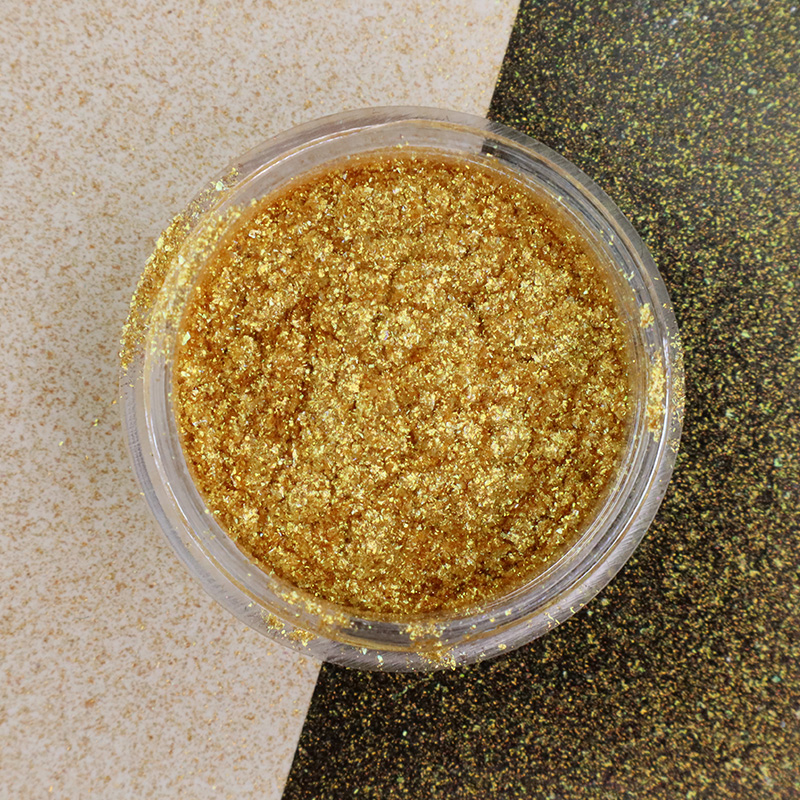
Special effect pigments are not simply colorants; they are optical devices. Their platelet structure reflects and refracts light across multiple layers, delivering depth, sparkle, and color travel that demand attention. Pearlescent pigments, for instance, consist of mica (or synthetic fluorophlogopite) coated with titanium dioxide or iron oxide. The thickness of the coating determines the interference color—from silver white to gold, red, blue, or green. Recent generations use synthetic mica for superior purity and consistent particle size distribution.
Particle size range dictates the visual effect. Below 15 µm, the finish is silky and uniform; between 20 and 100 µm, a prominent sparkle emerges; above 100 µm, individual glitter particles become visible—ideal for cosmetic packaging or luxury caps. However, the platelet structure is fragile. High-shear mixing in a co-rotating twin-screw extruder can shatter the platelets, turning a brilliant pearlescent into a dull, non-uniform film. The solution is often a conical twin-screw design that laminates rather than shears, preserving platelet integrity.
Pre-dispersion in a carrier resin matched to the final polymer is the safest route. Prepare a 50/50 masterbatch of pigment and low-melt-index polyolefin, then let down at 2–4% in the final part. Direct addition of powder to the hopper is possible, but static and dust loss often push yields below 95%. Count on 0.5–2% loading for a soft satin effect and 2–5% for high sparkle. Check that the base resin’s clarity is high—special effect pigments work best in transparent or translucent polymers like PET, PS, or clarified PP. In opaque resins like talc-filled PP, the effect essentially disappears.
Price per kilo can be deceptive. A high-performance organic pigment at $30/kg that requires only 2% loading may actually cost less per part than a cheap inorganic at $5/kg needing 8% loading—especially when you factor in scrap reduction, lower energy for dispersion, and warranty returns. The matrix below simplifies a multi-variable equation into a practical quadrant.
| Scenario | Low Durability Demand (indoor, <2 yr) e.g., disposable packaging |
High Durability Demand (outdoor, 5+ yr) e.g., automotive, construction |
|---|---|---|
| Small Volume (<10,000 parts/yr) |
Use standard organic masterbatch; focus on color matching, not weathering. Pigment cost: low-medium. | Choose high-lightfastness inorganic or coated special effect. Accept 15–30% higher pigment cost to prevent field failures. |
| Large Volume (>100,000 parts/yr) |
Negotiate blanket orders on organics; integrate in-line spectrophotometer to reduce scrap. Total cost increment minimal. | Invest in stabilized masterbatch with UV package. Inorganic pigments plus anti-yellowing additives deliver consistent color with near-zero warranty claims; cost premium drops below 10% at scale. |
Real-world example: a garden furniture maker switching from a generic red organic to a quinacridone-based pigment plus UV package saw upfront pigment cost rise 22%. However, scrap due to fading dropped from 4% to 0.2%, and customer complaints fell to zero, recouping the difference in under eight months. The key is to run accelerated weathering tests (QUV or Xenon arc) on production-intent parts, not just chip samples, and to evaluate the total cost of ownership over the product’s intended life.
Effective pigment selection marries chemistry, processing, and compliance into a single decision. Boil it down to a repeatable four-step workflow and you will avoid most of the pitfalls that plague first-time formulators.
Do not skip the sample step. A TDS will tell you that a pigment survives 300 °C for 5 minutes, but only your extruder can reveal whether it actually disperses well in your specific viscosity environment. Engage with pigment suppliers who offer application support and can recommend the right starting point—whether you need a conventional color-coated pigment or a tailored special effect additive. With a methodical approach, you will move from guesswork to a qualified, consistent color that holds up all the way to the end customer.

Contact Us
Mobile

 English
 Español