E-mail: [email protected]
Phone: +86-572-8356001
E-mail: [email protected]
Phone: +86-572-8356001
Content
Body shimmer and hair sparkle have quietly moved from festival season into everyday routines. A body oil with a soft golden veil, a hair mist that catches the light when you turn your head, a balm that makes collarbones look lit from within, these are standard shelf items now, and the people who make them are under real pressure to deliver glow without grit and sparkle without irritation.
If you have ever compared two shimmer products side by side and wondered why one looks like liquid candlelight while the other looks like glitter suspended in cooking oil, the answer usually is not the base oil or the fragrance. It is the pearl pigment inside. As a company that has spent years manufacturing pearlescent pigments for cosmetics and personal care, we see this question come up constantly: how do you choose pearls that are genuinely kind to skin and hair?
Pearlescent pigments are not glitter. Glitter is usually a plastic film cut into flakes and coloured with dye; it sits on top of a formula and announces itself. A pearl pigment is a fine powder made of thin, flat platelets, each one coated with layers of metal oxide such as titanium dioxide or iron oxide. Light hits the flat surface and bounces back in a single direction, which creates luster. When the coating is thick enough, light also interferes with itself inside the layer, producing the soft colour shifts you see in an interference or chameleon shade.
That structure is why pearls behave so well in body shimmer and hair sparkle. They disperse into oils, lotions, gels and balms rather than sitting on the surface, they work at very low doses, and their effect is directional, meaning the glow appears only when light hits at the right angle. That is what reads as skin rather than as decoration.
It also means the pigment has to do three jobs at once: look beautiful, stay suspended in the formula, and feel comfortable on the body. Those three jobs are where the idea of skin-friendly actually begins.
For formulators, skin-friendly is not a mood. It is a specification list.
We go into the safety differences between cosmetic and craft mica in more depth in this selection guide, but the short version is simple: if a product is going on someone's body or scalp, the pigment should be made for that purpose from the very start.
Every pearl pigment begins with a substrate, the flat plate that the oxide layers are built on. The substrate decides the character of the sparkle, the size range you can work with, and how the pigment feels once it dries down. Three families cover most body shimmer and hair sparkle projects.
| Substrate | Signature look | Typical particle size | Skin feel | Where it works best |
|---|---|---|---|---|
| Natural mica | Soft satin luster, gentle warmth | 10 to 60 microns | Smooth and cushiony | Body lotions, butters, tinted balms |
| Synthetic mica | Clean high chroma, crisp interference | 5 to 45 microns | Very smooth, low grit | Body and face highlighters, hair mists |
| Glass based | Intense, high clarity sparkle | 20 to 150 microns | Noticeable on dry skin | Body oils, glitter toppers, hair accents |
In practice, synthetic mica has become the workhorse for body and hair products that need a neutral base, because its tightly controlled platelets give a smooth skin feel and a colour that does not muddy the formula around it. Natural mica remains a good choice when the brief calls for a softer, more diffused satin glow with a mineral-origin story behind it. Glass-based pearls are the ones to reach for when the brief is full sparkle, but they need a base that can hold a heavier particle without settling out.
Particle size is the most practical lever you have, because it changes both the look and the feel of the finished product.
Hair changes the calculation. A strand is far thinner than a forearm and moves constantly, so a hair sparkle pigment needs to be small enough to sit between cuticles without looking like dust, and it needs to hold on through brushing. Fine synthetic mica and transparent holographic pearls tend to work best in mists, while slightly larger grades suit gels, waxes and texturising sprays where the formula itself gives the pigment something to grip.
Titanium dioxide is the most common coating material in pearlescent pigments, because it has a high refractive index and produces a bright, clean white reflection. It is also the ingredient that draws the most questions from brands working on sensitive-skin lines, free-from claims, or markets where the labelling conversation around titanium dioxide is still shifting.
Removing it is not as simple as skipping a step. The optical stack has to be rebuilt with alternative coatings so the pearl still delivers brightness and interference without turning a body oil chalky. The results are convincing when the chemistry is right: a titanium dioxide free silver-white pearl can read as a soft luminous veil rather than a white cast, which is exactly what an all-over shimmer needs.
If that is the direction your brief is heading, our titanium dioxide free pearlescent pigment range is worth a closer look, including the snow velvet silver-white grade and filler-grade synthetic mica options for formulas that need a functional powder as well as an effect.
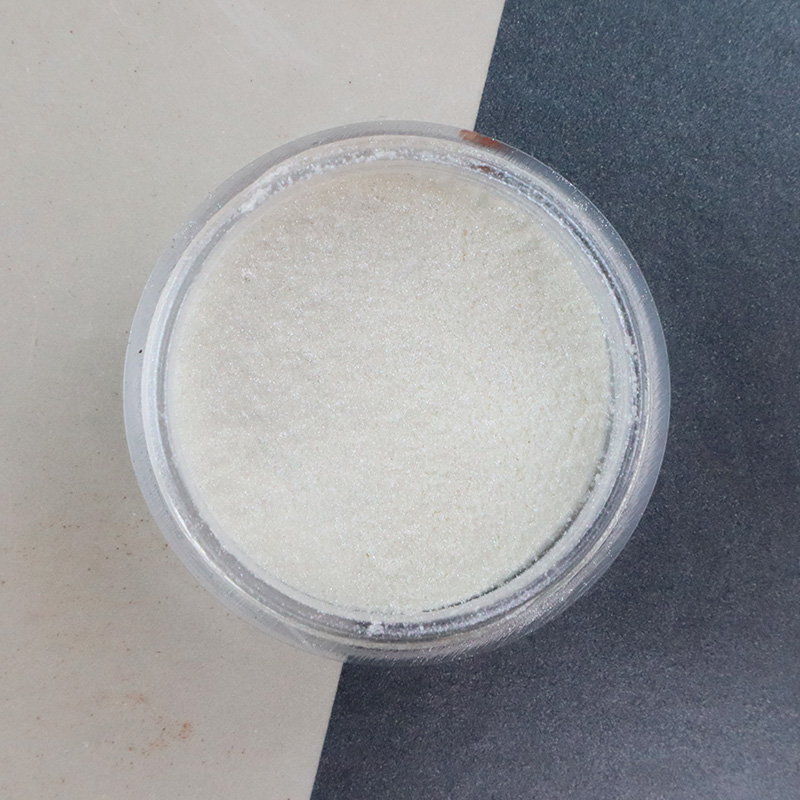 Titanium Dioxide Free Pearlescent Pigment RangeFor briefs seeking TiO2-free effects in eyeshadow, lipstick or foundation, this range includes snow velvet silver-white and filler-grade synthetic mica options.View Product →
Two pigments can share the same colour index and still feel completely different on skin. The difference is usually surface treatment. A silicone coating, for example, wraps each platelet in a thin lubricating layer that changes how the pigment interacts with oils, water and the skin surface.
For pressed highlighters, body balms and formulas with a high pigment load, treatment is often the difference between a product that still looks elegant after a week on the shelf and one that separates. Our silicone coated range was developed for exactly this kind of brief, pairing a soft skin feel with easier processing.
 Raysoft Silicone Coated Pearlescent Pigment CustomFor pressed highlighters, body balms or high-pigment loads, this silicone-treated mica-based pearl is customizable for better dispersion, soft feel and processing.View Product →
Once grade, substrate and size are settled, matching the pearl to the format is fairly straightforward.
Shade selection is its own small craft. Nude and champagne tones disappear into most skin tones and read as a natural sheen, which is why they dominate body shimmer. Platinum and antique shades give a cooler or more vintage cast, gold and saffron bring warmth, and silver-white stays the most versatile choice for hair. Nude skin tone pearls are a particularly useful starting point when the goal is a glow that flatters rather than announces itself.
 Nude Skin Tone Pearlescent Pigment Wholesale SeriesFor body shimmer, hair sparkle or a natural highlight, this nude-toned series offers multiple particle sizes and effects that blend with various complexions.View Product →
Choosing pearls for body shimmer and hair sparkle is not really about picking the shiniest option on the shelf. It is about matching a pigment's substrate, size, coating and treatment to the product you are building and to the skin or hair that will touch it. When that alignment is right, the sparkle looks effortless, because it is.
If you would like a starting point, our cosmetic and personal care application page shows how these pearls are used across colour cosmetics, skin care and wash-off formats. We are always happy to send samples and talk through the trade-offs, and that conversation usually saves more time than any catalogue can.

Contact Us
Mobile

 English
 Español