E-mail: [email protected]
Phone: +86-572-8356001
Content
Pearl effects in ceramic glazes and glass are easy to admire and surprisingly difficult to engineer. The shimmer is not a simple colorant sitting on the surface; it is light interacting with thin films, crystals, or fine surface textures. A mica-based effect pigment can look convincing in a binder at room temperature, yet the same powder may lose its interference color, turn hazy, or dissolve when it meets a glaze melt at 1,100°C or a glass melt above 1,400°C. That gap between appearance and thermal reality is the heart of high-temperature pearl processing.
Pearl is an optical effect, not a pigment color. In conventional pearlescent pigments, platelet-shaped substrates are coated with thin metal oxide films. Light reflects from the top and bottom of the film, and the two reflections interfere. Film thickness controls the hue; platelet size and alignment control sparkle and coverage. In a fired ceramic, a similar look can come from three very different routes: an effect pigment dispersed in the glaze, a metallic lustre decoration, or crystals that grow in the glaze during cooling. Each route has its own temperature ceiling and failure modes.
Clear language helps. A “pearl white” glaze may mean a milky opal white, a soft metallic sheen, or an angle-dependent pink-green shift. Those are not interchangeable targets. Before selecting a material, describe the desired appearance in terms of gloss, opacity, color travel, sparkle size, and surface texture.
Ceramic glazes are usually fired between 1,000°C and 1,300°C, while many glass melts run hotter still. At those temperatures, the ingredients of a pearlescent pigment face several risks. Mica can lose structural water and deform; titanium dioxide coatings can change phase and react with glaze fluxes; iron oxide coatings can dissolve; and the sharp optical interfaces that create interference can be smoothed away. Alkali and boron-rich glazes are especially aggressive. A pigment that performs well in a low-temperature overglaze decoration may fail completely in a stoneware glaze.
Thermal stability is therefore system-specific. A datasheet can tell you the chemistry of a pigment, but it cannot predict how that pigment will behave in your glaze, on your clay body, at your peak temperature, with your soak and cooling profile. The practical rule is simple: test the fired system, not just the powder.
 Industrial Interference Pearlescent Pigment SeriesThis wholesale series covers multiple interference-effect grades in several particle sizes and rutile type, offering a reference for controlled formulation trials.View Product →
For industrial formulators who need a reference point for how coating thickness shifts interference color, our interference pearlescent pigment series illustrates the optical principle well. It is not automatically a kiln additive; it is a starting point for a controlled trial.
| Route | What creates the effect | High-temperature reality | Typical fit |
|---|---|---|---|
| Mica-based pearlescent pigment | Thin TiO2 or mixed-oxide film on platelets | Mica and coating may degrade; interference can fade or dissolve | Low-temperature decoration, overglaze, or non-ceramic effect systems |
| Metallic lustre | Thin metal film from resinates or similar | Often fired around 700–850°C; thin and abrasion-sensitive | Decorative ware, artware, low-wear surfaces |
| Crystalline glaze | Devitrification of rutile, zinc silicate, or other crystals | Can survive high firing; depends on cooling and glaze chemistry | Durable pearly or moonlit glazes when kiln control is good |
| Opal glass | Scattering particles or phase separation | Bulk melt route; effect is milky rather than angle-dependent | Tableware, containers, decorative glass |
Glaze chemistry often matters more than pigment grade. Silica and alumina build the glass network; feldspar, borax, and other fluxes lower the melting point. A glossy, transparent glaze gives an effect pigment the best chance to show interference, because light can enter and leave without too much scattering. A matte or heavily opacified glaze scatters light in many directions and can wash out the pearl effect. Thick glaze layers may bury small platelets; very thin layers may not provide enough optical path.
Firing profile is just as important. A long hold at peak temperature gives the melt more time to attack the pigment. Fast cooling can freeze crystals at a useful size, or it can lock in stress. Reduction firing may alter oxide coatings. Even kiln furniture and atmosphere can influence the final shade. For repeatable results, record the full curve, not only the top temperature.
In a bulk glass melt, a thin-film pigment has little chance of surviving; the melt is corrosive, and the optical structure is likely to dissolve. Pearl-like glass is therefore usually made by other means: opal glass with scattering particles, controlled surface crystallization, acid etching, lustre decoration, or dichroic coatings. Glass-ceramic glazes can produce attractive pearl effects through controlled devitrification. Titanium dioxide or other nucleating agents may help crystals grow, but that is a different mechanism from adding a pearlescent pigment powder.
If your process involves a glass melt, treat a pearlescent pigment as a surface or low-temperature decoration option until proven otherwise. Do not assume that a pigment designed for coatings or plastics will survive a glass tank.
Pearl effects fail in recognizable ways. Color loss and haze are common when the coating dissolves or the platelet surface is roughened. Pinholes and blisters can appear if the pigment introduces gas or disrupts the glaze melt. Crawling may follow poor wetting or excessive loading. Uneven luster usually points to poor dispersion, platelet alignment, or local glaze thickness variation. Metallic specking can occur when a pigment agglomerate survives the firing. Crazing is a glaze-body mismatch, but it becomes more visible on a reflective surface. Yellowing in light-colored glazes can come from iron or titania reactions, kiln atmosphere, or overfiring.
 Anti-Yellowing Pearlescent Pigment for PlasticsFor plastic applications where yellowing is the concern, this AY-treated series includes white grades for masterbatch, injection, and extrusion.View Product →
For light-colored industrial effects, our anti-yellowing pearlescent pigment range is one reference point when yellowing is the specific concern, though glaze and firing chemistry still dominate. A useful diagnostic sequence is to fire the same glaze with and without the effect pigment, then compare gloss, haze, color, and defect population under the same lighting.
Our laboratory page describes the kind of application testing that supports this work, but the basic sequence can be reproduced in most ceramic studios and technical centers. The aim is not to prove that one pigment is universally best; it is to find the effect route that survives your process and your use conditions.
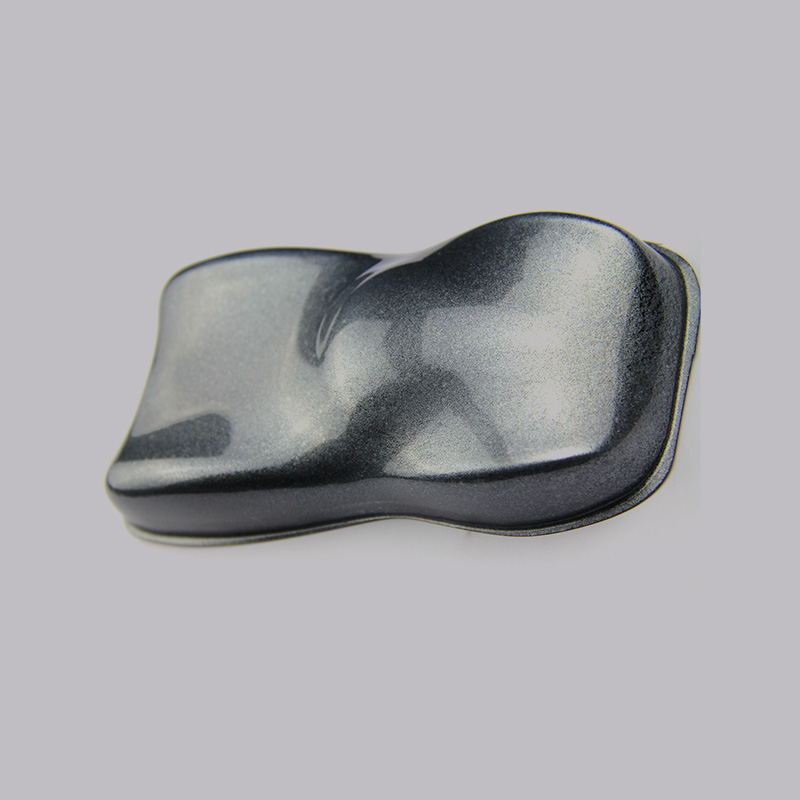 RAYSUM Weather-Resistance Pearlescent Pigment RangeThis category covers RAYSUM weather-resistant grades with non-chrome treatments and varied colors and particle sizes for outdoor-exposure screening in polymer or coating systems.View Product →
When the finished part will face outdoor exposure, our weather-resistance pearlescent pigment range is a sensible screening candidate for the polymer or coating side of a hybrid construction. For a fired glaze, the kiln trial remains decisive.
Tableware and food-contact ceramics demand more than a beautiful surface. The glaze must resist thermal shock, cleaning agents, and abrasion, and the effect must remain locked in the fired layer. Wall tile, floor tile, and sanitaryware bring weathering, cleaning, and mechanical wear into the picture. Artware can accept a more delicate lustre or a shorter service life. Architectural and packaging glass usually separates bulk color from surface decoration, because tempering and forming conditions rarely forgive a heat-sensitive additive.
Our industrial application fields page groups these use cases by performance demand, which is a useful reminder that a pearl effect surviving firing but wearing off in cleaning is not a success. The right question is not “which pigment is best?” but “which effect route survives my firing curve and my use case?”
High-temperature pearl effects reward a process-first approach. Define the optical target, check the glaze or glass chemistry, run controlled firings, and measure what comes out. A supplier can narrow the field by explaining coating chemistry, particle size, and thermal limits, but only the kiln can confirm the result. Pearl effects that last are designed around the process, not added at the end.

Contact Us
Mobile

 English
 Español